
Tents & Shelters
How Many People, and How Long to Put It Up
Two questions answer most of this. How many people are sleeping in it, and how long you are prepared to spend getting it up in fading light with everyone watching.
Those two pull against each other. Big family tents take longer and reward a second pair of hands. Small ones go up in minutes and hold two. Which matters more depends on whether you are moving on every night or staying put for a week.
Fast Frame, Dome and the Lighter End
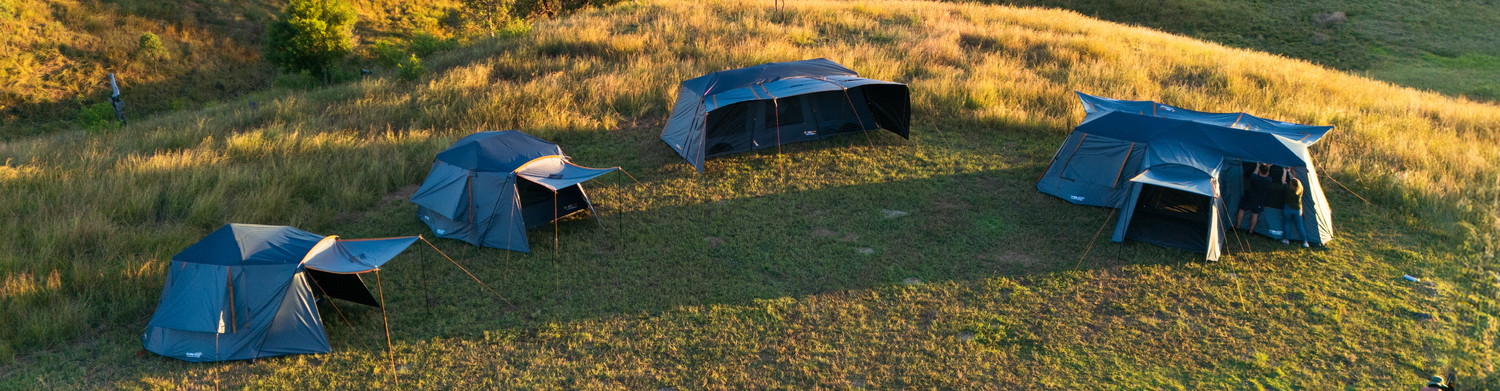
Fast Frame is the quick-pitch end, from a 3P up to a 12P, including the BlockOut Lumos versions. The frame stays attached to the tent, which is what takes the time out of setup.
Dome tents are the traditional shape and the widest choice here, running 2P, 3P, 4P, 6P, 9P and 10P. Lighter again are the Cradle tents in 1P to 3P and a two-person pop-up pod, while stretcher tents put a single sleeper on a frame off the ground entirely.
Seven Groups, Sorted by Shape
Seven groups cover the tents and shelters:
- Fast Frame tents. Quick-pitch tents from 3P to 12P, including the BlockOut Lumos line.
- Dome tents. The broadest choice, from a 2P through to 9P and 10P family domes.
- Lightweight tents. Cradle tents in 1P, 2P and 3P, plus a pop-up pod for two.
- Stretcher tents. Single and double tents built onto a stretcher frame, off the ground.
- Ensuite tents. Standing shelters for a shower or a toilet, in single, double and vehicle versions.
- Personal shelters. The Hiker and Camper flies, for shade and weather cover without a full tent.
- Swags. Canvas swag sleeping, rolled out rather than pitched.
Pegs, poles, guy ropes and swag accessories sit in their own sections.
Reading Person Ratings Properly
A person rating measures floor width, not comfort. A 4P sleeps four mats edge to edge with nowhere to put bags, which is why plenty of couples buy a 4P and plenty of families of four buy a 6P.
Add a size if you want room for gear, a stretcher instead of a mat, or somewhere to sit out a wet afternoon. Then check the pitched footprint against the site, because a 10P dome needs more flat ground than a lot of powered sites give you, and a four-seasons-in-a-day forecast is a poor time to find that out.
Where a Fly or an Ensuite Earns Its Space
Not everything here is something you sleep in. The Hiker and Camper flies are open shelters, which is what you want over a picnic table or a cooking area rather than over a bed, and they go up with a fraction of the fuss.
Ensuites solve the other problem. A standing shelter with no floor gives you somewhere to put a shower or a portable toilet, in single and double widths, with a version that attaches to a vehicle and a pop-up privacy dome for a quick setup. On a long stay at a site without a shower block, an ensuite changes the trip more than a bigger tent would.
Shop Tents and Shelters at OZtrail NZ
The right tent is usually one size up from the one that technically fits, and it is the purchase that shapes every trip you take with it afterwards. Anything over $150 ships at no charge, and the peg and pole section is there for ground where the supplied pegs will not hold.